- Anvith Industry
- Buying Guide
- 0 Comments
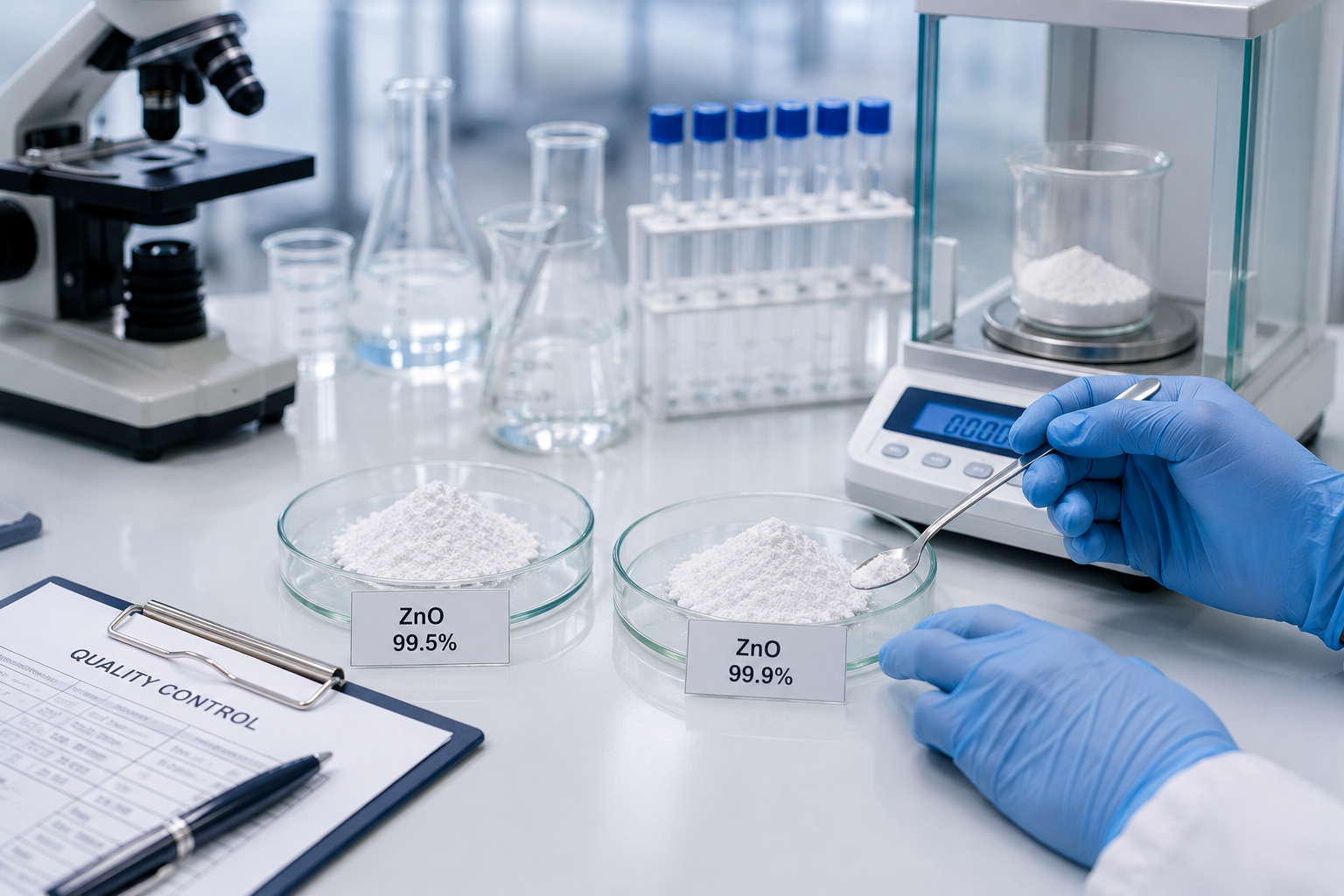
When sourcing zinc oxide, one of the first specifications buyers encounter is purity – typically expressed as a percentage somewhere between 99.5% and 99.9%. It is a small-looking number range, but the difference can meaningfully affect how a formulation performs, which is why understanding what purity actually controls is worth a few minutes before placing an order.
What the Remaining Percentage Actually Contains
Zinc oxide purity refers to the proportion of the material that is pure ZnO, with the remaining fraction made up of trace elements and processing residues such as lead, cadmium, iron or sulphate compounds, depending on the raw material and production method used. Lower-purity grades generally carry a higher concentration of these trace elements, which may or may not matter depending on your application.
When 99.5% Purity Is Perfectly Adequate
For many industrial applications – including rubber vulcanization, certain paint formulations, and general ceramic glazing – 99.5% purity zinc oxide performs reliably and cost-effectively. These applications are typically more tolerant of minor trace-element variation, since the zinc oxide’s primary role (activation, fluxing, opacity) is not highly sensitive to small impurity levels.
When You Need 99.7% to 99.9% Purity
Applications with stricter regulatory or performance requirements – pharmaceutical products, cosmetics, sensitive electronics and precision adhesives – generally require zinc oxide at the higher end of the purity spectrum. In these cases, trace heavy metals or inconsistent particle characteristics can affect safety compliance, electrical performance or formulation stability, making the extra purity a functional necessity rather than a premium upgrade.
Particle Size Is a Separate but Related Specification
Purity and particle size are often discussed together but are technically independent specifications. A high-purity zinc oxide can still have inconsistent particle size distribution if production controls are lacking, which is why buyers evaluating suppliers should ask for both purity certification and particle size data (often reported as D50 or specific surface area) rather than relying on purity percentage alone.
Anvith Industry manufactures zinc oxide across the 99.5%–99.9% purity range with controlled particle size and composition, backed by batch-level quality documentation. Contact our team to identify the right specification for your application.